3 Hours, Marine Biologist Guide
La Paz Whale Shark Swims · 3 hours
★ 4.9 · 649 reviews · From $178
Check availability →A whale shark swim in La Paz is a tightly scripted half day: a morning meet-up on the Malecon or at a marina, a run out to the swim zone under federal rules, five swimmers per guide beside the biggest fish in the sea, and a boat back before lunch. Here is how the sequence works, hour by hour.
Short answer
Expect a 3 to 4 hour outing: meet at a Malecon pier or marina, ride 20 to 40 minutes to Zone I, take turns in the water in groups of five per guide for up to 30 minutes with a shark, and return. Shared swims on the roster run from $110 to $295 per person.
The day is shorter and more structured than most first-time visitors imagine. A whale shark swim in La Paz is not an all-day expedition unless you deliberately book a combo or a Los Cabos day trip; the standard shared swim is a 2 to 4 hour outing that starts at a pier or marina in the city, crosses a short stretch of the bay, and puts you in the water beside the largest fish species on the planet under some of the strictest wildlife-swim rules anywhere. This guide walks through that sequence step by step, using the federal regulations that govern every boat in the water and the verified listing details of the operators on La Paz Whale Shark Tours.
The season that frames all of this runs 1 October 2026 to 30 April 2027, under a SEMARNAT aviso that issued 112 authorizations, one per holder, one boat, one pennant. Four swim shifts run each day, and the whole operation only works when at least six whale sharks are present in Zone I of the refuge. Every detail below follows from that framework. Before you slip into the water, it helps to know whether touching a whale shark is legal under Mexican rules, since the same regulations that set the season also forbid contact and define how close you may swim.
Most shared swims in La Paz meet between roughly 7 and 10 in the morning at one of a handful of verified departure points, most of them on or near the Malecon, with a briefing, gear handout and a short boat ride before the first shift of the day. The whole outing typically lasts 2 to 4 hours, so you are usually back on the boardwalk before lunch.
3 Hours, Marine Biologist Guide
La Paz Whale Shark Swims · 3 hours
★ 4.9 · 649 reviews · From $178
Check availability →Operators report that departure slots are assigned daily by the authorities, with common windows in the early morning, mid-morning, around noon and early afternoon, and most operators ask guests to confirm their exact slot the evening before. The meeting points cluster in three places: the Muelle Fiscal pier on Paseo Alvaro Obregon, where several roster operators including Alonso Tours and Mexico Travel Adventure gather; Marina de La Paz at Calle Topete 3040, home to Tuna Tuna Tours and Orza Tours; and a scattering of shopfront offices a few blocks inland, such as MeXplore on Topete 125 and Eco Migrations on Mutualismo 342.
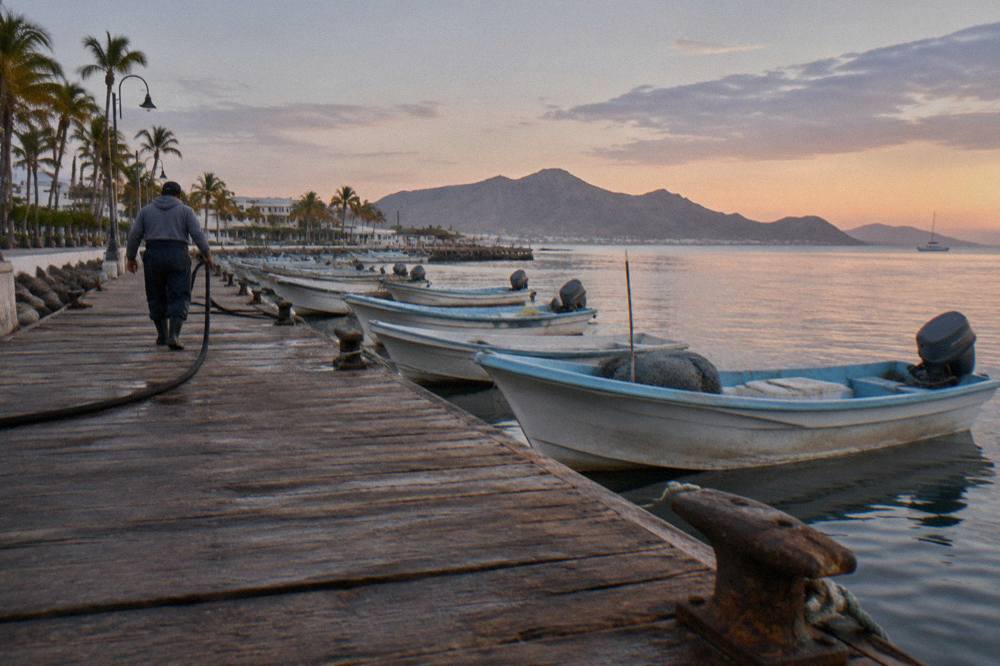
What this means practically is that where you sleep matters less than you might think. The pier and the marina are a short walk or a few minutes by taxi from most central hotels, a point covered in more depth in the where to stay guide for whale shark swimmers. Arrive with what the day requires, a towel, a sweatshirt for the boat, biodegradable sunscreen only, and the knowledge that the rules in the water are not optional suggestions; they are federal norms enforced by inspectors on the water. The full packing list is covered in what to bring for a whale shark swim.
Here is where the main roster operators actually meet, verified per listing:
| Operator | Departure point | Swim duration | Price basis |
|---|---|---|---|
| Alonso Tours | Muelle Fiscal, Paseo Alvaro Obregon 220 | 2 to 4 hours | from $122 per person |
| Tuna Tuna Tours | Marina de La Paz, Calle Topete 3040 | 3 hours | from $178 per person |
| MeXplore | Topete 125, La Paz | 3 hours | from $178 per person |
| Sunrider Tours | Marina ASIPONA, Calle Recinto Portuario 110 | 2 hours 30 minutes | from $110 per person |
| Eco Migrations | Mutualismo 342, La Paz | 4 hours | from $194 per person |
| Baja Wild Adventures | Playa SN-C, Restaurante Bar La Costa | 3 hours 30 minutes | from $159 per person |
Most La Paz swims do not list hotel pickup, though Punta Baja offers it and La Paz City Map provides it on request. Among the Los Cabos day trips, only Cabo Adventures and BallardTours include pickup. If meeting a pier at 7 in the morning sounds like a burden, the alternative is paying for one of the three day trips that start in Los Cabos and drive you up, at from $259 to $399 per person for 7 to 10 hours door to door.
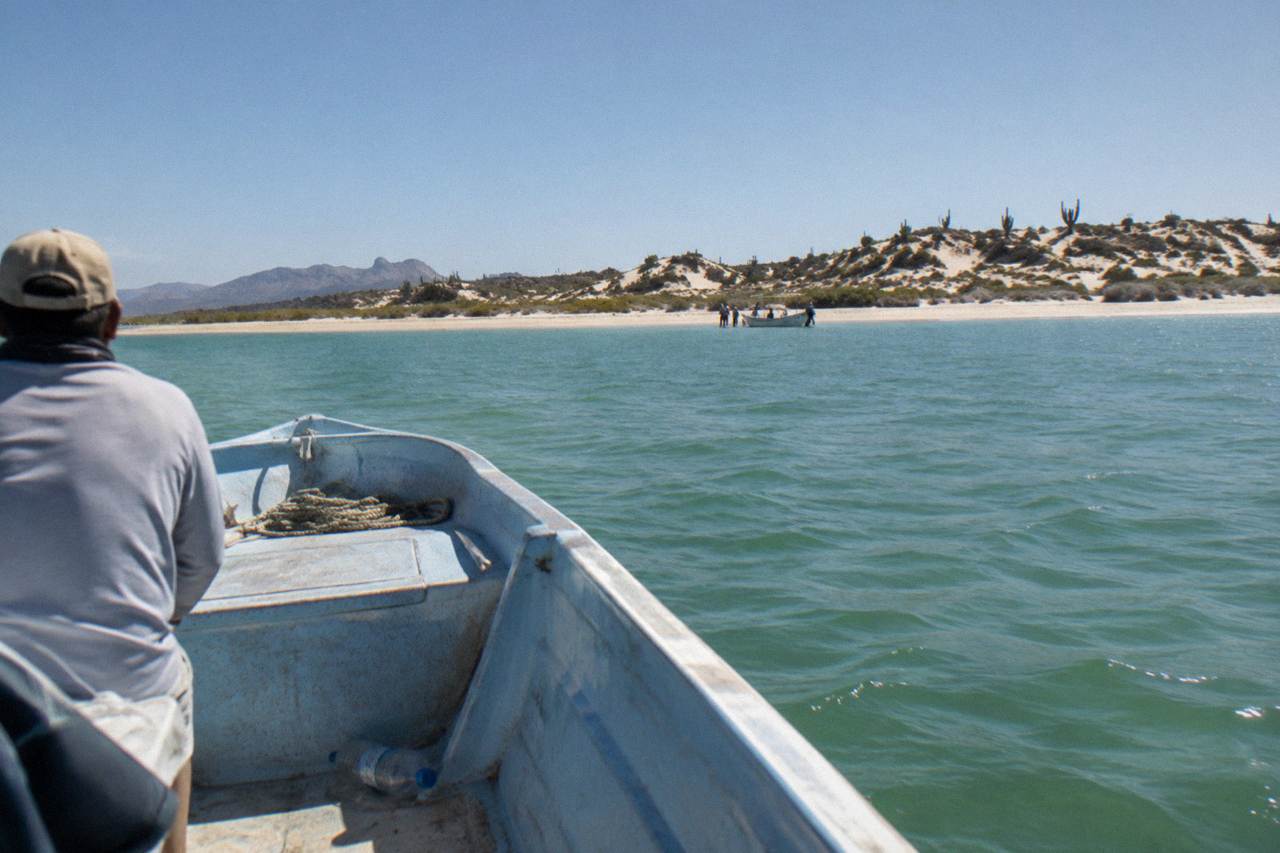
Operators report the boat ride from the dock to the whale shark swim zone takes 20 to 40 minutes, across a bay that is itself a federally decreed refuge of 22,749 hectares divided into three zones. Only Zone I, the aprovechamiento zone, permits swimming and watching; the boat crosses Zone III transit water at a maximum of 7 knots to get there. That protection is a big part of why whale sharks rank among the sights La Paz is best known for, along with the sea lions of Espiritu Santo and the calm shallows of Playa Balandra.
The geography is worth understanding because it explains the pace of the morning. The Area de Refugio Bahia de La Paz was decreed on 29 November 2018 to protect the whale sharks that feed in the shallow, plankton-rich water just off the city. Zone II is a conservation area where no activity with the species is allowed, and Zone III is transit-only water with a speed cap of 12.9 km/h, the same 7-knot limit that applies to boat approaches generally. The decree itself is published on the official federal gazette.
Once the boat nears an aggregation, the rules tighten further: 3 knots inside aggregation zones, and other boats waiting their turn hold 50 m back while one boat at a time works a shark or a group. Boats are limited to 11 m in length, approach from behind and parallel to the shark's path rather than head-on, and hold at least 5 m off before swimmers go in.
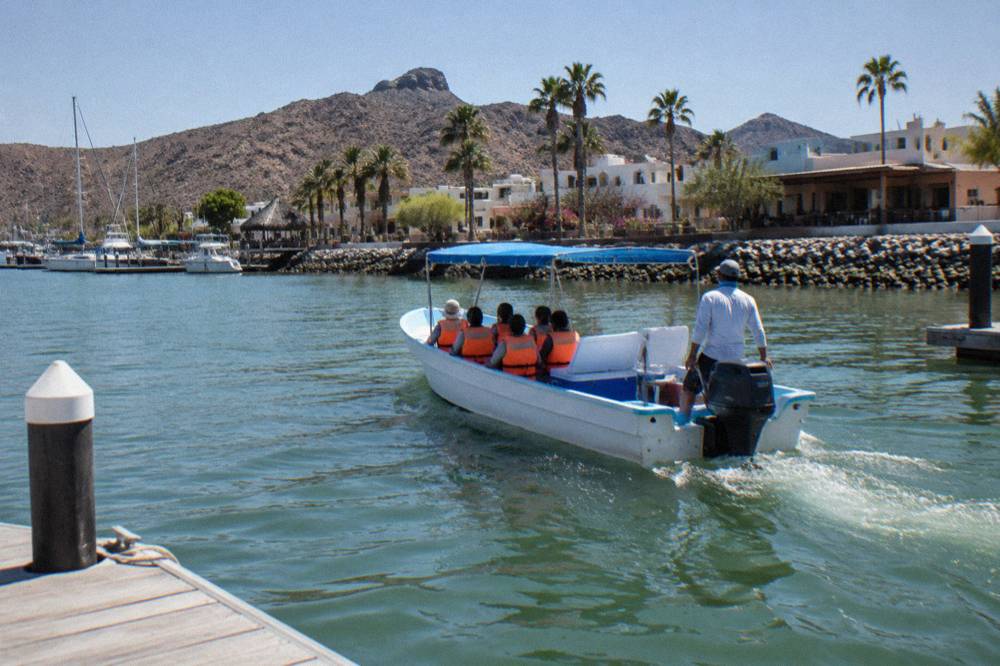
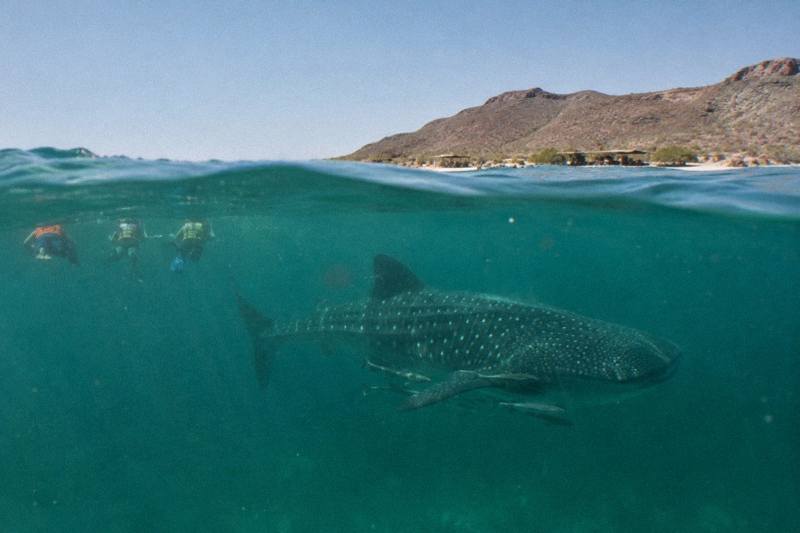
Because the ride is short, most of the tour's stated duration is dock time, briefing, gear and water time. A 3-hour listing typically breaks down as roughly 30 to 40 minutes of check-in and briefing, 20 to 40 minutes out, an hour or more in and around the swim zone across your group's turns, and the run home. The premium reduced-group encounter, an intimate eco-friendly swim from The Dock Cafe on the Malecon, runs from $295 per person for 3 hours with a 5.0 rating across 422 reviews; the marine-biologist small group from MeXplore, from $178 per person, includes federal permits and the conservation donation, gear, wetsuits and GoPro photos in its stated inclusions.
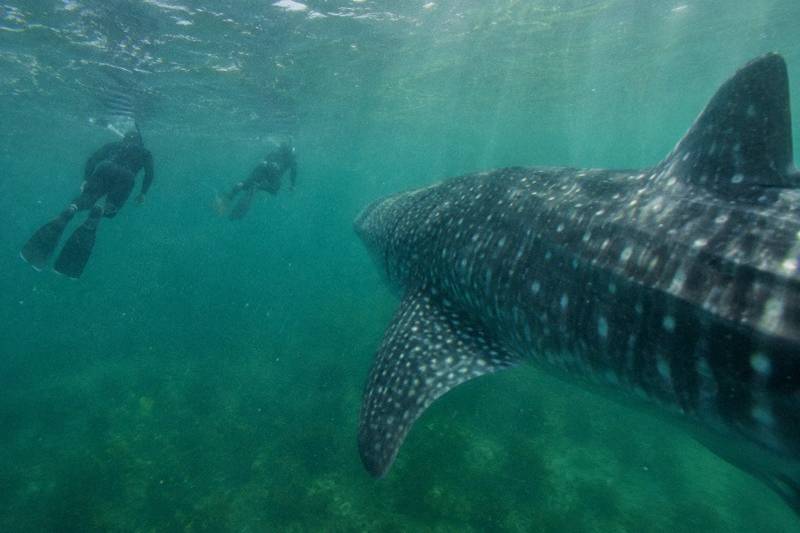
NOM-171-SEMARNAT-2018 allows five swimmers per specialised guide, kept together as a group, with 2 m of clearance beside the shark's head and sides and 3 m from its tail. Swimmers enter from about 15 m ahead of the animal with the engine in neutral, wearing a life vest or wetsuit, with biodegradable sunscreen only and no flash, no selfie sticks and no touching under any circumstances.
The norm, published in the federal gazette and readable on the official NOM-171 text, treats the swim as a managed wildlife encounter rather than a free-for-all. Descending swimmers ahead of the shark's path with the engine in neutral is the detail most visitors remember: the boat does not chase the animal, it positions itself so the shark swims toward the swimmers, who then hold their lane and let the fish pass beneath and beside them. Guides control the group of five the whole time, and the activity with any individual shark ends the moment it shows evasive swimming, defensive tail strikes or a sudden dive.
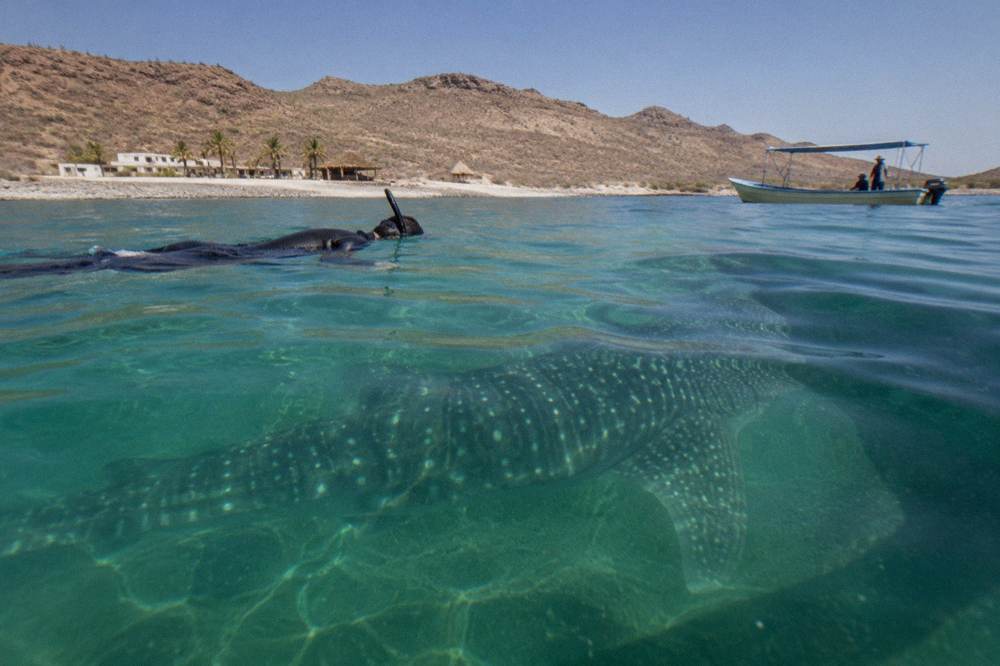
Touching, riding and feeding are prohibited outright, a point this site covers in depth in is it legal to touch a whale shark. The species is listed as threatened under NOM-059-SEMARNAT-2010, and PROFEPA inspects boats on the water alongside CONANP to verify authorizations and rule compliance. You can read the broader ethical framing in is swimming with whale sharks ethical, but the short version is that the La Paz rulebook is among the stricter ones in Mexico precisely because the refuge exists.
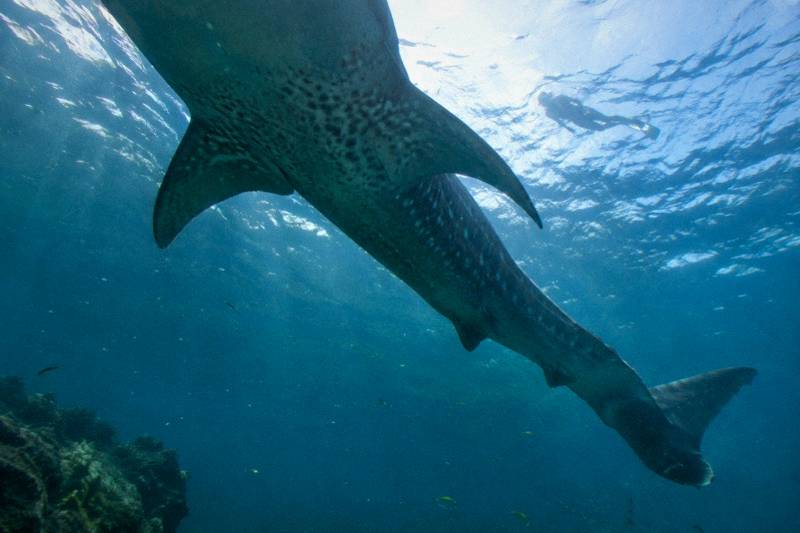
Here is the in-water rule set in one view:
| Rule | What NOM-171 says | What it means for you |
|---|---|---|
| Swimmers per guide | 5, kept together | You swim in a small controlled group, not a crowd |
| Distance from the shark | 2 m beside head and sides, 3 m from the tail | Stay in your lane; the guide enforces it |
| Time per shark or group | One boat at a time, maximum 30 minutes | Other boats wait 50 m away |
| Entry | 15 m ahead of the shark, engine in neutral | The shark swims to you, never the reverse |
| Boat speed | 7 knots maximum, 3 knots in aggregation zones | Slow approaches, no chasing |
| Gear | Life vest or wetsuit; biodegradable sunscreen only | Vests and suits are standard on roster listings |
| Prohibited | Touching, riding, flash, selfie sticks, motorised devices | Photos yes, harassment no |
| Stop rule | Evasive swimming or tail strikes end the encounter | The animal always has the exit |
Wetsuit thickness is a comfort question more than a rule question. Season sea temperatures in La Paz average roughly 20 to 21 C in the coolest months and run near 26 to 29 C early in the season, and operators advise a 3 mm shorty up to a 5 mm full suit for that band. Most roster listings include wetsuits or a vest in the stated inclusions, so check the live listing rather than assuming you need to bring your own.

A single boat may spend up to 30 minutes with one shark or one group of sharks, and only one boat works that animal at a time while others wait 50 m away. Within that window, your guide rotates small groups of five swimmers, so each swimmer's continuous time in the water is typically a few minutes per turn, often with multiple turns if the shark stays.
This is the number that surprises people most. The 30-minute cap in NOM-171 belongs to the boat, not to you, and it exists to keep the encounter from becoming harassment. In practice, guides run a rotation: five swimmers in with the guide, a stretch alongside the shark, everyone back on board, the next five in. If the shark is feeding steadily near the surface, the rotation repeats. If it dives, the turn is over and the boat repositions or returns to port. The stop rule protects the animal, and the season's minimum-six threshold protects the whole operation.
Boats per shift scale with how many sharks the official counts find, which is why some days feel busy and others do not:
| Sharks counted in Zone I | Boats per shift | Boats per day |
|---|---|---|
| 0 to 5 | 0 | 0 |
| 6 | 6 | 24 |
| 7 to 9 | 7 | 28 |
| 10 | 8 | 32 |
| 11 | 9 | 36 |
| 12 | 10 | 40 |
| 13 | 11 | 44 |
| 14 or more | 14 | 56 |
The counts are the average of the two most recent official CONANP surveys, rounded up, and four shifts run per day. The 14-boat hard cap in the swim zone is what keeps the water from crowding even in a strong month. Last season closed with 56 individual sharks identified and 950 sightings recorded by the close of 30 April, with 11 still present at season's end; no counts have been published yet for the 2026-27 season, so nobody can honestly tell you how this year compares.
Within those constraints, the experience differs by listing. The Eco Migrations small-group swim caps the boat at 6 guests, from $194 per person for 4 hours with snorkel gear and a full wetsuit included, rated 4.8 across 56 reviews. The intimacy of a smaller boat does not change the rules, but it changes how quickly the rotation comes back to you.
For the same reason, the premium encounter above is the listing that most directly sells a calm, low-density version of the day: from $295 per person, 3 hours, all fees and taxes, gear, snacks and even SPF 50 biodegradable sunscreen in the stated inclusions, with a 5.0 rating across 422 reviews. Whether that is worth the premium over the from $110 Sunrider swim is a value question the cost guide breaks down line by line.
The return leg mirrors the outbound: 20 to 40 minutes across the bay at transit speeds, usually with snacks or drinks served depending on the listing, a debrief on the dock, and a late-morning or early-afternoon finish on the Malecon. Many visitors spend the rest of the day on the free things La Paz does well, the boardwalk itself, or a paid afternoon at Balandra.
The stated inclusions vary more on the way home than at any other point. Tuna Tuna Tours includes snacks, water and wetsuits on its basic swim; the MeXplore listing states light refreshments plus GoPro photos and videos of your tour; the premium La Paz Whale Sharks VIP Tours encounter adds soda and biodegradable sunscreen; the Alonso Tours listing notes it skips bottled water in favor of purified water in a container with glasses. Towels are the near-universal exclusion, listed as excluded on several rosters, so bring your own.
If the half-day format leaves you wanting more water time, the natural upgrade is a combo that adds the sea lion colony at Los Islotes and a beach stop. Swimming with sea lions there operates under its own cap, 180 persons in the restricted subzone at once, and the colony is closed to swimmers from 1 June to 31 August for the reproductive season, reopening about 1 September to 31 May, per the CONANP management plan. The Espiritu Santo island tour guide covers that side of the bay in full.
If you would rather stay closer to town in the afternoon, Balandra runs two daily access turns, 08:00 to 12:00 and 13:00 to 17:00, capped at 450 visitors per turn with a reported MXN 120 per person fee, confirm on the day; the Balandra access guide has the detail.
Under the 2026-27 aviso, if CONANP counts five or fewer sharks in Zone I, no trips operate at all, and boats per shift scale upward from six sharks. Seasonal suspensions have genuinely happened before, in early 2023 and again in late January 2025 after counts fell to 9, 5 and then 1 shark, so a flexible plan beats a rigid one.
The minimum-six rule is the single most important fact for anyone booking in advance. In January 2025 SEMARNAT suspended swimming and watching in the bay after three consecutive official counts came in low, and the suspension was still in place into March. The 2025-26 season as a whole opened in November and closed on schedule on 30 April with a healthy 56 identified individuals, so suspensions are the exception rather than the rule, but they are a real part of how this refuge works. The suspension guide tracks the current status.
Two practical hedges follow. First, book early in your stay, not on your last day, so a weather or count closure can be rescheduled; the eastern Pacific hurricane season runs 15 May to 30 November with peak risk August to October, which is why early-season trips carry more weather risk than January ones. Second, check the operator's cancellation and reschedule terms on the live listing before you pay, because those terms are set by the operator. December, January and February are the months sources consistently report as peak abundance.
Travelers based in Los Cabos face one extra layer: the day trips run 7 to 10 hours door to door because of the roughly 160 km drive each way, which leaves less slack in the schedule if a morning shift is dropped. The Cabo to La Paz day trip guide covers that trade-off.
By the end of a standard morning you will have been on the water three or four hours, swum a few minutes at a time beside an animal the length of a bus, and learned a set of federal rules by living them. That is the whole shape of the day, and it is enough.
Shared swims on the roster run 2 to 4 hours door to dock, with 3 hours the most common format. Combos that add sea lions and a beach run 6 to 9 hours, and Los Cabos day trips run 7 to 10 hours including the drive.
No operator may promise that. Trips only run when at least six sharks are counted in Zone I, and counts drive a sliding boat cap. The encounter with any shark ends if it shows evasive behavior, and suspensions have occurred in past seasons.
NOM-171 sets 2 m beside the head and sides and 3 m from the tail. Five swimmers per guide enter 15 m ahead of the shark with the engine in neutral, and touching, riding and flash photography are prohibited.
A life vest or wetsuit is required in the water, and several listings include both. Swimmers stay with a guide in a group of five, but comfort in open water matters; check the listing for the operator's own health and swimming rules, as none are stated on the roster.
Operators report that departure slots are assigned daily by the authorities, with common windows from early morning to early afternoon across four shifts. Most operators ask you to confirm your slot the evening before.
Age limits, minimum ages and health policies are not stated on the roster listings, so check the listing for the operator's rules before booking for children.
Before you go, the pick for this guide:
Premium Reduced-Group Encounter
★ 5.0 422 reviews · From $295
Check availability →