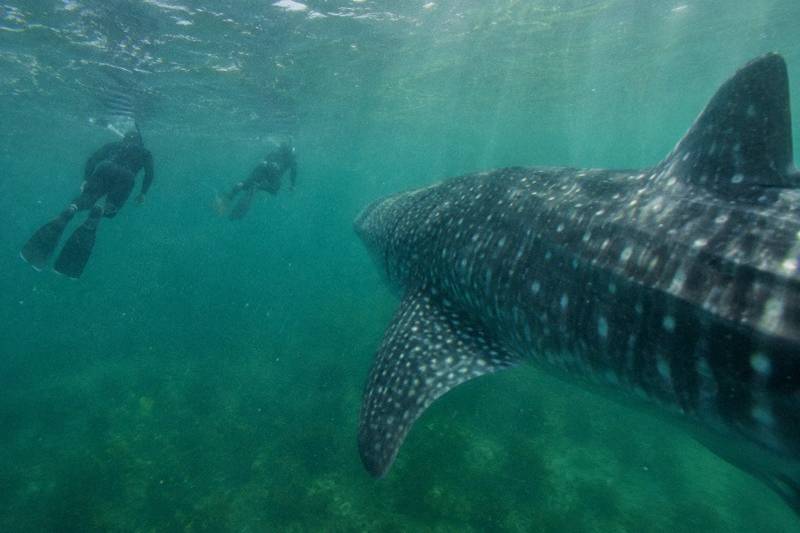
Is It Legal To Touch A Whale Shark? Why Touching Is Banned
No, touching a whale shark is not legal in Mexico. NOM-171-SEMARNAT-2018 bans touching, riding and chasing, sets 2 m and 3 m swim distances, and PROFEPA enforces the rules in the La Paz refuge.
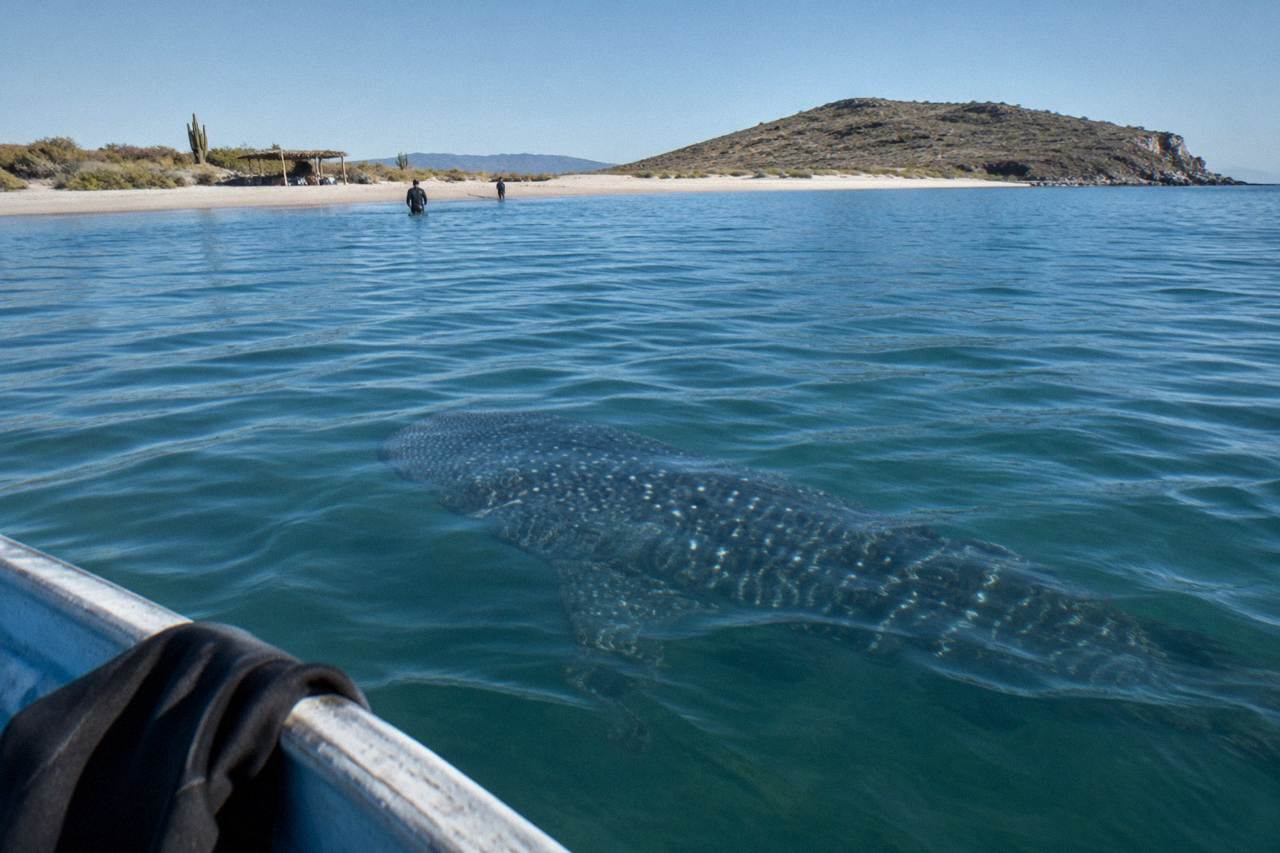
No, touching a whale shark is not legal in Mexico, and NOM-171-SEMARNAT-2018, in force since February 2020, bans it. The national standard prohibits touching, riding and chasing the species outright, and in La Paz the activity happens inside a federally decreed refuge where PROFEPA inspects boats. Swimmers must stay 2 m from the head and sides and 3 m from the tail, full stop. If you're still weighing where in the country to plan your trip, this guide to swimming with whale sharks in Mexico compares La Paz with Cancun, Holbox and Isla Mujeres.
The question comes up constantly, and honestly so. A whale shark looks slow, placid and close enough to pat, and the animal's sheer size makes people assume contact is harmless. The law takes the opposite view. The norm, published in the official gazette on 19 November 2019, lists touching among the prohibited behaviors alongside riding and any pursuit of the animal. The species is classified as threatened under NOM-059-SEMARNAT-2010, and the whole regulatory structure around the La Paz bay swim exists because the animals return to the same water every year and need to keep doing so.
It is worth being precise about what the ban covers, because the word "touching" undersells the scope. The norm prohibits a family of behaviors: touching the animal with any part of your body, riding it in any fashion, chasing or pursuing it, using motorised propulsion devices in the water, and extending selfie sticks or using flash and artificial light for photography. All of those are treated the same way, as intrusions into the animal's space that the species' threatened status cannot afford. A swimmer who never reaches out but chases the shark across the bay is breaking the same norm as one who pats its back.
This matters for how you book, not just how you behave once you are in the water. The featured marine-biologist small group swim from MeXplore is built around exactly this: a certified guide controls a small group of swimmers in the water, which is the mechanism NOM-171 uses to keep distances honest. The premium reduced-group encounter run by La Paz Whale Sharks VIP Tours takes the same idea further. Neither listing promises contact, because no legal listing can. If a tour anywhere advertises touching, that tour is advertising something the law forbids. If the swimming itself is what worries you, whether you actually need strong swimming skills for whale sharks covers how the same rules that keep swimmers at a distance also look after nervous beginners.
The rest of this article walks through what the norm actually says, why the distances are what they are, how enforcement works on the water, and what a legal swim feels like in practice. For the deeper regulatory background, the companion guide on NOM-171 swim rules in La Paz breaks down every numbered requirement.
What NOM-171-SEMARNAT-2018 Actually Says About Contact
The norm prohibits touching, riding or chasing whale sharks, and it structures the entire swim around avoiding contact rather than punishing it after the fact. Boats must approach from behind and parallel, no closer than 5 m, and swimmers enter the water from 15 m ahead of the animal with the engine in neutral. Each guide controls five swimmers, kept together as one group.
The full text of the standard is public on the official gazette page, and the prohibited behaviors are listed plainly there. Touching is banned. Riding is banned. Chasing is banned. So are motorised propulsion devices, selfie sticks, and flash or artificial light for photography. Swimmers must wear a life vest or a wetsuit, and only biodegradable sunscreen may be applied before entering the water. None of these are operator house rules that vary from boat to boat; they are a national norm that applies to every authorized operator in Mexican waters.
The five-swimmers-per-guide ratio is the piece people underestimate. It is not a comfort or marketing number. It exists because a guide can only keep a group coherent, and therefore at legal distance, if the group is small enough to control. When ten people scatter across the water, distances collapse within seconds. When a guide holds five swimmers in a tight cluster on one side of the animal, the 2 m and 3 m buffers stay realistic for the full 30 minutes a boat is allowed with one shark.
A point that surprises many readers: the activity with any individual shark ends the moment the animal shows evasive swimming, defensive tail strikes, a sudden direction change or a prolonged dive. This stop rule is written into the norm itself, which tells you the framework is built around the shark's behavior as the deciding factor, not the paying customer's schedule.
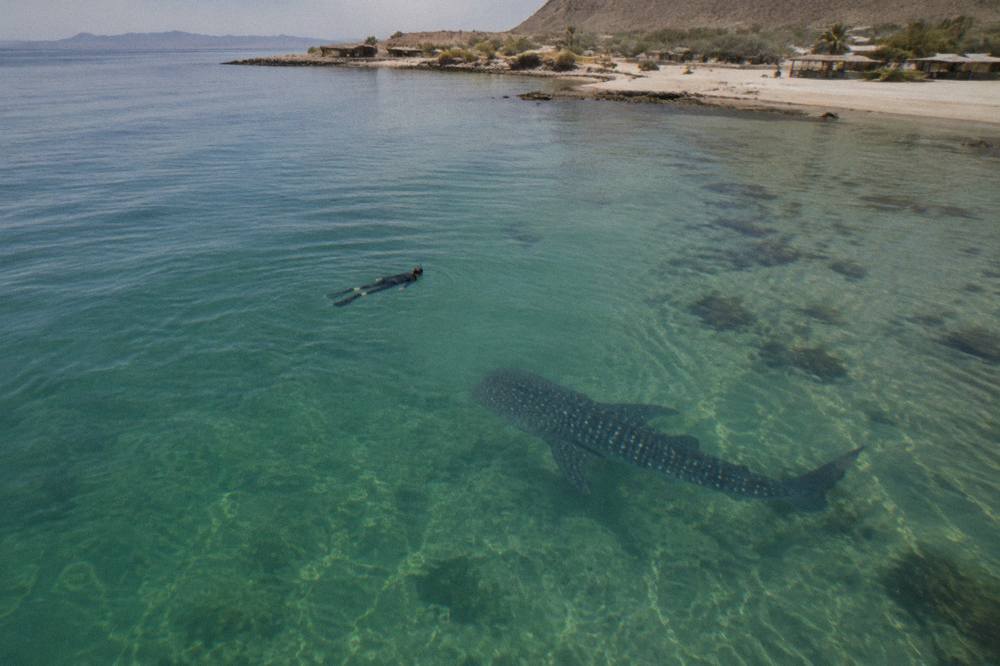
Here is the rulebook in one view:
| Rule under NOM-171 | What it means in the water |
|---|---|
| No touching, riding or chasing | Hands stay at your sides or on your camera; you never reach toward the animal |
| 2 m from head and sides | You swim parallel, never cut in front of the shark's path |
| 3 m from the tail fin | The tail is the wide, fast-moving end; a strike is a real injury risk |
| 5 swimmers per guide | Groups stay bunched; the guide positions you relative to the shark |
| One boat per shark, 30 minutes max | Other boats wait 50 m away; no crowding |
| Boat approach from behind, parallel, 5 m minimum | The shark is never boxed in or surprised from the front |
| Stop rule on evasive behavior | The swim with that shark ends immediately |
A few of these rows deserve a sentence of why. The 30-minute cap exists so that no single animal carries the whole day's tourism load; with four daily shifts and a sliding cap on boats, the system spreads encounters across many sharks rather than exhausting a few. The 50 m stand-off distance for waiting boats keeps the water around an active swim from turning into a flotilla. And the engine-in-neutral entry requirement means the shark is never swimming toward a propeller, which protects both parties in the most literal way the rulebook can.
Why The Distances Are Two Meters And Three Meters
The 2 m buffer beside the head and body and the 3 m buffer from the tail exist because of geometry and physics. A whale shark's caudal fin sweeps a wide arc as it moves, and even a slow glide moves a lot of water and fin with it. Three meters behind the animal is the minimum space for that sweep not to reach a swimmer.
Two meters sounds tight, and beside the head of a fish that can exceed several meters in length it is, but the number is calibrated to how the animals actually feed and travel. Whale sharks in the La Paz bay are most often juveniles moving steadily through plankton-rich water near the surface. A swimmer holding 2 m to the side travels comfortably alongside that path. A swimmer reaching in collapses the buffer and, more importantly, changes the animal's behavior, which triggers the stop rule and can end the swim for everyone on the boat.
There is also a legal-design logic. Distances are enforceable in a way that intentions are not. A guide on the boat, and an inspector from PROFEPA working with CONANP, can see whether a group is holding a legal position relative to the animal. "Being respectful" is not observable from 50 m away; a 2 m gap is. That is why the norm specifies meters rather than leaving spacing to judgment. It converts a shared value into a checkable fact.
The distances also protect the thing that makes the whole experience possible. The bay is a formal refuge, the Area de Refugio Bahia de La Paz, decreed on 29 November 2018 across 22,749 hectares and divided into three zones; only Zone I allows swimming and watching, Zone II is closed conservation area, and Zone III is transit-only at 7 knots. The decree is on the gazette site. Sharks that get harassed learn to avoid boats, and the season simply stops producing encounters. The 2025-26 season closed with 56 individual sharks identified and 950 recorded sightings, per news reports quoting CONANP, and that kind of repeat visitation depends on the animals not being grabbed at.
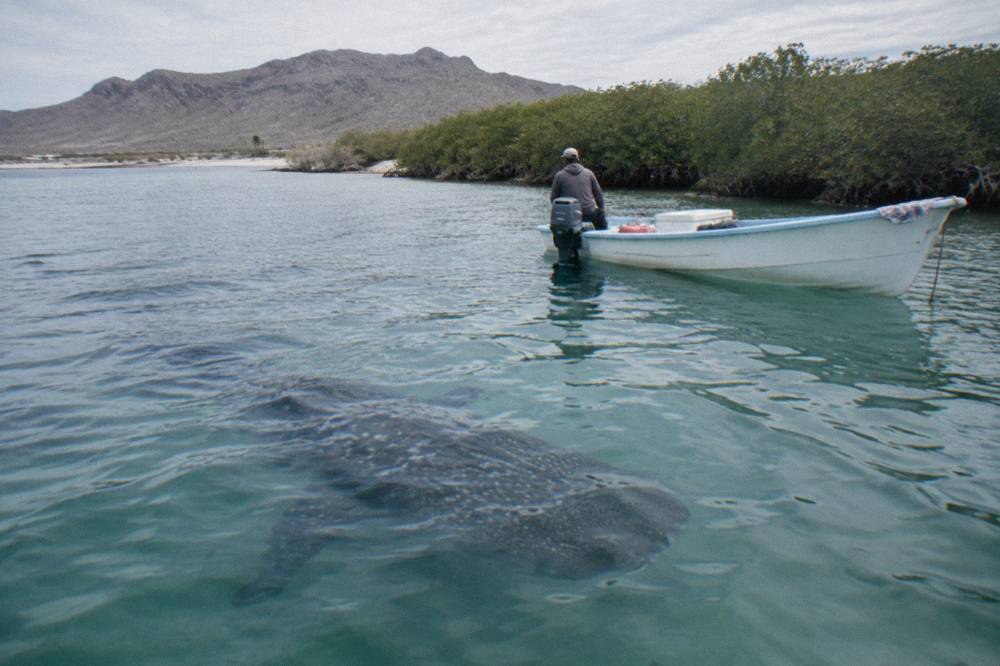
If you are weighing whether a tightly guided tour is worth it compared with the cheapest boat on the dock, the honest framing is that the guide is the product. More on that trade-off in whether whale shark tours are worth the price.
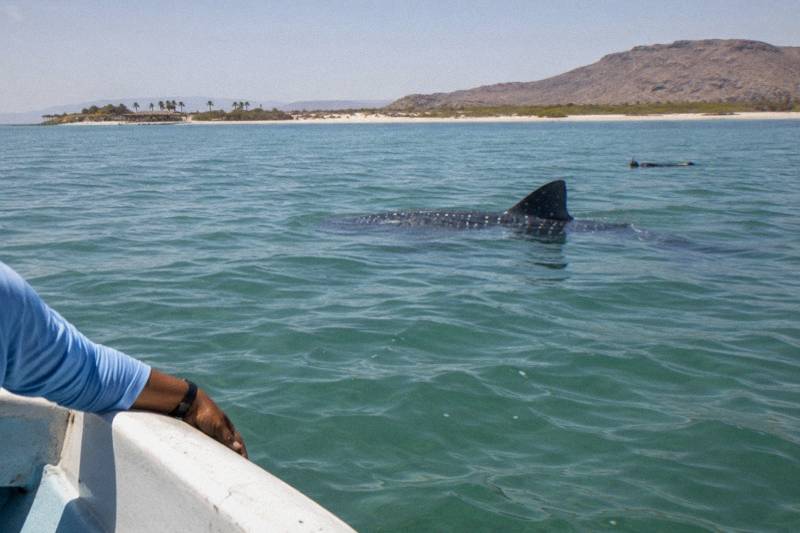
How The Rules Are Enforced On The Water
Enforcement runs on two layers. SEMARNAT issues a capped number of authorizations, each tied to one holder, one boat and one pennant, while PROFEPA, coordinated with CONANP, carries out inspection and surveillance on the water to verify compliance and the terms of each authorization. For the 2026-27 season, 112 authorizations were issued.
The pennant system, called the banderola, is what a visitor can actually check. An authorized boat displays its SEMARNAT pennant, carries an original or certified copy of its authorization on board, and measures no more than 11 m. No public list of the 112 current holders was found in official sources, so the practical check is what you can see at the dock and what the operator can show you. The season framework also sets hard operating conditions: at least 6 sharks must be present in Zone I for trips to run at all, and boats per shift scale with the official count, capped at 14 vessels at once.
What this means for the touching question is that contact is not just rude, it is a compliance failure on a licensed boat. An operator who lets a guest touch a shark is risking the authorization that their whole season depends on, which is why guides are strict about hand position and group cohesion in the water. The norm's stop rule backs this up from the animal's side: the moment a shark shows evasive swimming or a defensive tail strike, the encounter is over.
The season's own history shows why the regulators are conservative. Swimming was suspended in late January 2025 after official counts fell to 9, then 5, then a single shark over eight days, and in early 2023 the activity was suspended for low counts as well. When the animals are scarce, boats stay ashore. That is the system working as designed, and it is the system your ticket money enters when you book a legal tour.
Operators build their products around these constraints. Sunrider Tours runs a budget swim from $110 per person rated 4.4 from 155 reviews, while Baja Wild Adventures runs a marine-biologist trip from $159 per person rated 4.9 from 109 reviews. The differences are in guiding and inclusions, not in the legal baseline: every one of them operates under the same no-contact rule. The table below shows how the roster's better-reviewed local swims stack up, all of them no-touch products by law.
| Tour | Operator | Price basis | Rating and reviews |
|---|---|---|---|
| Small Group Whale Shark Snorkeling Tour with Marine Biologist | MeXplore | from $178 per person | 4.9 from 649 reviews |
| Small Group Whale Shark Snorkeling in La Paz | Tuna Tuna Tours | from $178 per person | 5.0 from 454 reviews |
| Intimate Eco-Friendly Whale Shark Encounter | La Paz Whale Sharks VIP Tours | from $295 per person | 5.0 from 422 reviews |
| Whale Shark Adventure with a Marine Biologist | Baja Wild Adventures | from $159 per person | 4.9 from 109 reviews |
| Whale Shark Swim Adventure | Sunrider Tours | from $110 per person | 4.4 from 155 reviews |
Premium Reduced-Group Encounter
La Paz Whale Shark Swims · 3 hours
★ 5.0 · 422 reviews · From $295
Check availability →What A Legal Swim Looks Like From Inside The Water
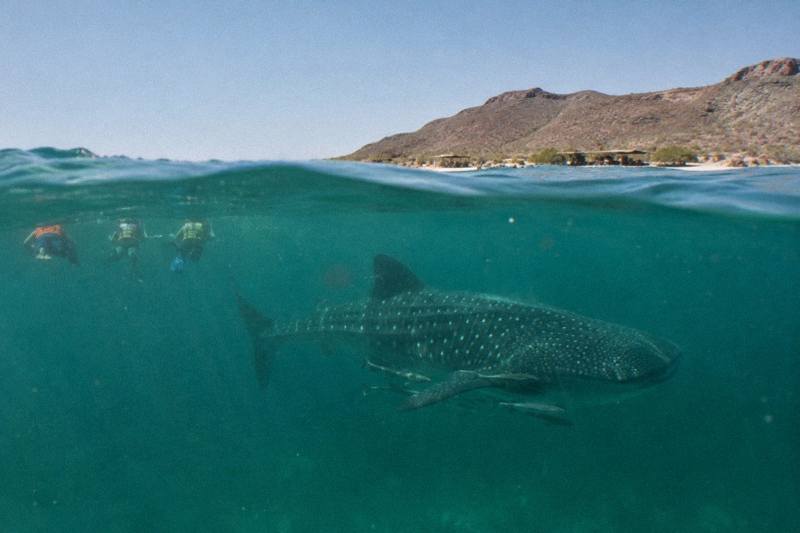
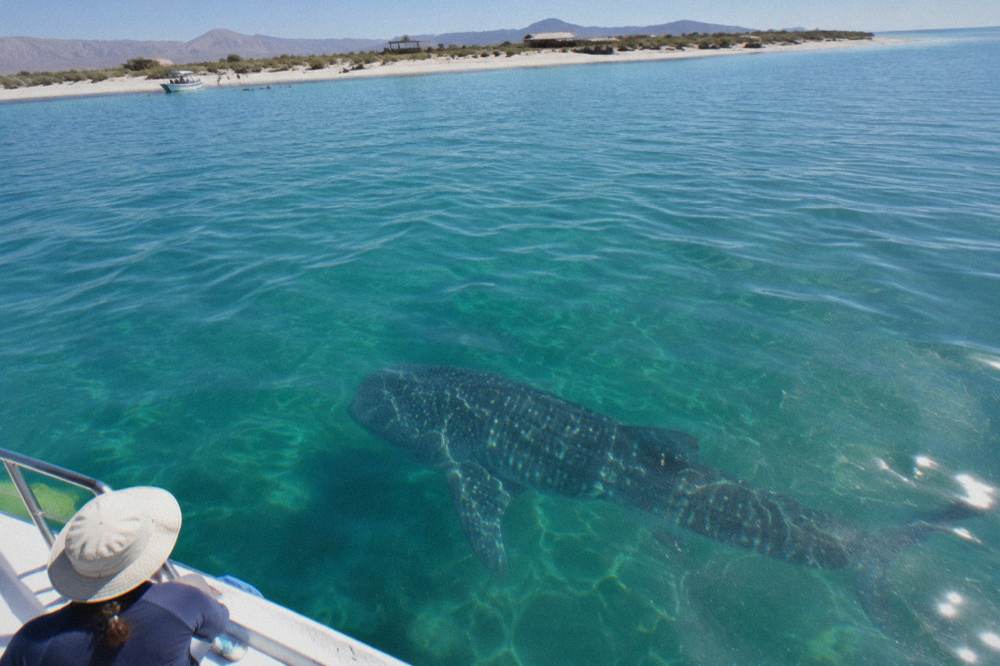
A legal swim is a parallel float, not an approach. The boat drops you ahead of the shark with the engine in neutral, the guide positions your small group beside the animal's path, and you kick alongside watching it feed, typically for a stretch of minutes before the boat rotates the next group in. Hands stay home; the animal does the moving.
The shark, often a juvenile several meters long, materializes out of the blue and passes close enough that its pattern of pale spots is sharp and clear. Nothing about the 2 m rule makes that less astonishing. What the rule removes is the reach, and most people in the water find they do not miss it: the animal is so large that proximity is already total.
The mechanics come straight from the norm. Swimmers enter from a position 15 m ahead of the shark so the animal approaches them rather than the reverse, which is the least intrusive geometry available. The guide keeps the five-swimmer group together and calls direction changes. The boat holds back, because one boat per shark is the limit and 30 minutes is the clock. When the shark dives or turns away, the encounter is finished and the boat moves off.
Tours package this differently. The Tuna Tuna Tours small group swim includes wetsuits, all fees and underwater pictures from $178 per person, rated 5.0 from 454 reviews. The MeXplore marine-biologist tour, from $178 per person and rated 4.9 from 649 reviews, the most reviewed swim on the local roster, includes the federal permits and a conservation donation, snorkel gear and wetsuits, and a certified guide and captain. The premium encounter from La Paz Whale Sharks VIP Tours, from $295 per person with a 5.0 rating from 422 reviews, sells reduced group size and biodegradable SPF 50 sunscreen as part of the package. Every one of them is a no-touch product by law, not by choice.
For the ethical questions that sit behind the legal ones, the companion piece on whether swimming with whale sharks is ethical goes deeper into the conservation argument.
Why The Ban Protects The Experience You Paid For
The no-contact rule is what keeps the sharks coming back, and returning sharks are what make the season exist. The bay's juveniles return each autumn because the water feeds them and the encounters do not hurt them. Touching, chasing and crowding teach animals to avoid boats, which converts this season's sightings into next season's absence.
The numbers make the point. The 2025-26 season recorded 56 identified individuals, 20 of them new juvenile records, and 950 sightings across the window, with 11 animals still present at the April close. A bay that sustains that kind of repeat visitation is doing something right, and the regulatory load, from the refuge zoning to the five-per-guide ratio to the 30-minute cap, is the mechanism. For travelers weighing where that balance still exists, the best place in Mexico to swim with whale sharks makes a clear case for La Paz.
The stop rule deserves a second look here because it is the clearest signal of the whole framework's priority. If a shark shows evasive swimming, defensive tail strikes, a sudden change of direction or a prolonged dive, the activity with that animal ends. The customer's paid half-hour does not override the animal's behavior. Any operator running under a SEMARNAT pennant accepts that trade, and any operator that would not accept it is not running legally.
It is also worth being honest about the temptation. People ask "is it legal to touch a whale shark" because the impulse is real, and the answer needs to address the impulse, not just the statute. Keeping your hands at your sides is not a bureaucratic hoop; it is the price of the animal staying within sight at all.
There is a useful comparison with how the refuge manages its other famous residents. At Los Islotes, the sea lion colony inside the neighboring Espiritu Santo park, swimming is closed entirely from 1 June to 31 August for the reproductive season and capped at 180 people in the water at once when open, per the CONANP management plan. The whale shark rules follow the same philosophy: the animals' calendar sets the humans' calendar. The La Paz Whale Shark Tours roster exists inside that structure, and every listing on it prices a regulated experience rather than an unrestricted one.
Common Questions About Touching Whale Sharks
Can you get fined for touching a whale shark?
Violations of the norm carry sanctions, but this site does not state fine amounts because no verified figure is on file. What is verified is the enforcement structure: PROFEPA with CONANP inspects boats and verifies the terms of each of the 112 season authorizations, and an operator who allows contact risks that authorization.
What happens if a whale shark swims toward you?
The rule binds your behavior, not the animal's. You maintain your distance and let the shark pass; NOM-171 requires 2 m beside the head and body and 3 m from the tail fin. If the animal changes course to avoid your group, the stop rule ends the encounter, and the boat moves on.
Is it legal to touch a whale shark anywhere else in Mexico?
No. NOM-171-SEMARNAT-2018 is a national standard, so the no-touch rule applies wherever regulated whale shark swimming happens in Mexico. Other regions have their own local frameworks on top, and this site holds no verified data for them, so check locally before booking outside La Paz.
Why do the guides keep groups to five swimmers?
The norm sets five swimmers per specialised guide, kept together, because a small controlled group is the only way to hold legal distances reliably. Larger groups scatter, buffers collapse, and the encounter has to end. It is a compliance mechanism that happens to make for a better swim.