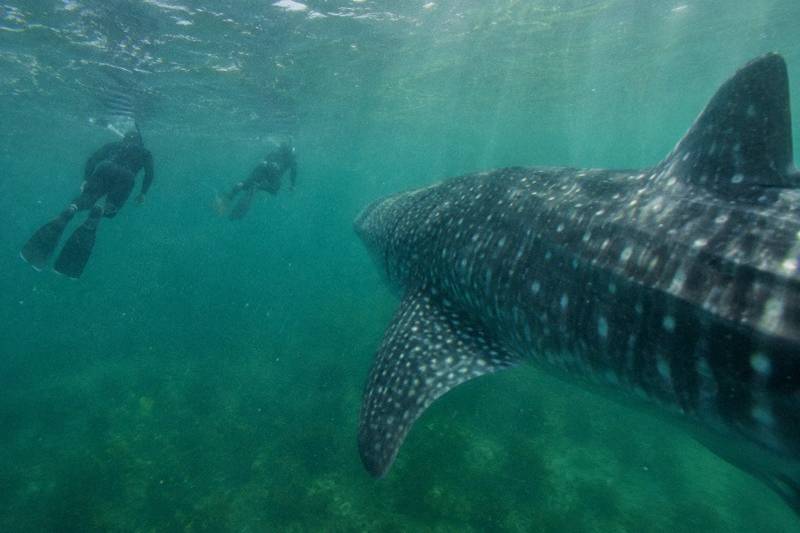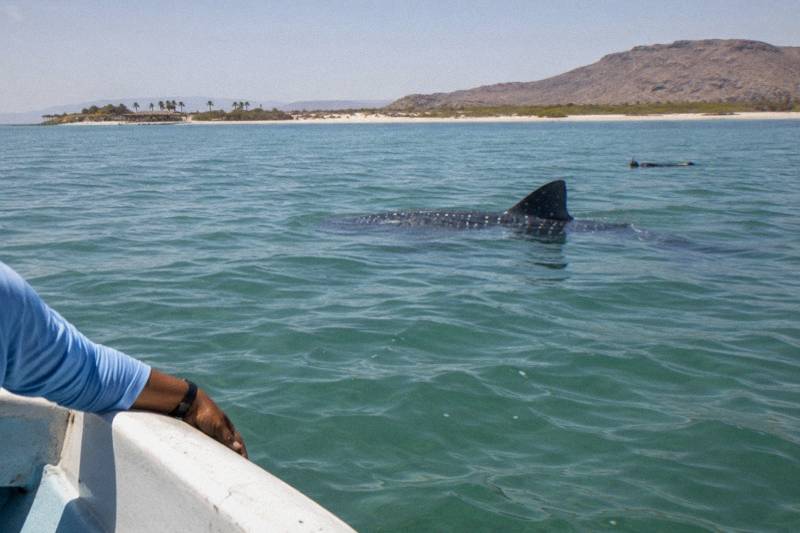
Whale Shark Swim Rules In La Paz: What The Law Requires
Every swimmer in the water off La Paz is covered by a federal norm, NOM-171-SEMARNAT-2018, that fixes distances, group sizes, boat behavior and a hard ban on touching. Here is what it says, and how to check your operator follows it.
Short answer
NOM-171-SEMARNAT-2018 requires swimmers to stay 2 m from a whale shark's head and sides and 3 m from its tail, in groups of 5 per guide, from boats no longer than 11 m holding a SEMARNAT pennant. Touching, flash, selfie sticks and motorised devices are banned. Operators in La Paz run from $110 to $295 per person.
Swimming with whale sharks in La Paz is not a free-for-all. It is one of the most tightly regulated wildlife swims in Mexico, governed by a federal norm called NOM-171-SEMARNAT-2018, published in the Official Gazette, that sets distances to the animal, limits swimmers per guide, caps boat length and speed, and lists behaviors that end the encounter on the spot. The 2026-27 season, which runs 1 October 2026 to 30 April 2027, adds a seasonal aviso with 112 authorizations issued under a strict one-authorization, one-boat, one-pennant scheme.
Knowing the rules does two things for a visitor. It sets expectations, so the minutes beside a shark feel like the privilege they are rather than a short ride. And it works as a buyer's filter: an operator who cannot tell you the distance rules, or whose boat shows no pennant, is telling you something. The listings that make a point of the rulebook, like the marine-biologist small group from MeXplore, which lists federal permits and the whale shark conservation donation among its inclusions, are signaling that they operate inside it. If you're asking the same question for younger swimmers, the guide to kids swimming with whale sharks in La Paz covers what the rules and tour listings mean for families.
What Rules Apply To Swimming With Whale Sharks In La Paz?
The governing document is NOM-171-SEMARNAT-2018, a federal norm published in the Official Gazette on 19 November 2019, in force since 17 February 2020, that regulates every observation and swim with whale sharks in Mexico. In La Paz it is layered with a seasonal SEMARNAT aviso and the rules of the Bahia de La Paz refuge, decreed in 2018, which divides the bay into three zones where different activities are allowed. Given how many rules govern a single swim, you might reasonably wonder whether a whale shark has ever attacked a person, and the short answer is no.
The norm's full title describes exactly what it covers: the specifications for non-extractive activities for the observation and swimming with the whale shark, Rhincodon typus, for its protection and habitat conservation. You can read the official text on the DOF site. It applies to operators and swimmers alike, which surprises people: the person in the water also has legal obligations, not just the captain.
On top of the norm sits the seasonal aviso. For the 2026-27 season SEMARNAT issued 112 authorizations, each tied to one holder, one boat and one pennant, and set a minimum of six sharks in the swim zone before any trips may run, with five or fewer sharks meaning no operations that day. Four daily shifts structure the activity, and the number of boats allowed per shift scales with the official shark count. That sliding scale, and why suspensions happen, is covered in the guide to swim suspensions in La Paz.
| Rule layer | What it covers | Who enforces it |
|---|---|---|
| NOM-171-SEMARNAT-2018 | Distances, swimmer groups, boat behavior, prohibitions, gear | SEMARNAT via PROFEPA |
| Seasonal aviso 2026-27 | Dates, 112 authorizations, minimum shark count, shifts, boats per shift | SEMARNAT and CONANP |
| Bahia de La Paz refuge decree | Three zones, transit speed, activity boundaries | CONANP |
| Species listing (NOM-059) | The whale shark is classed as threatened in Mexico | SEMARNAT |
The refuge itself is real geography, not a line on a flyer. The decree of 29 November 2018 created the Area de Refugio Bahia de La Paz, 22,749 hectares of territorial sea in front of the city, specifically to protect the whale shark. What those three zones mean for a swimmer, and for a boat captain, is set out further down this page.
How Close Can You Swim To A Whale Shark In La Paz?
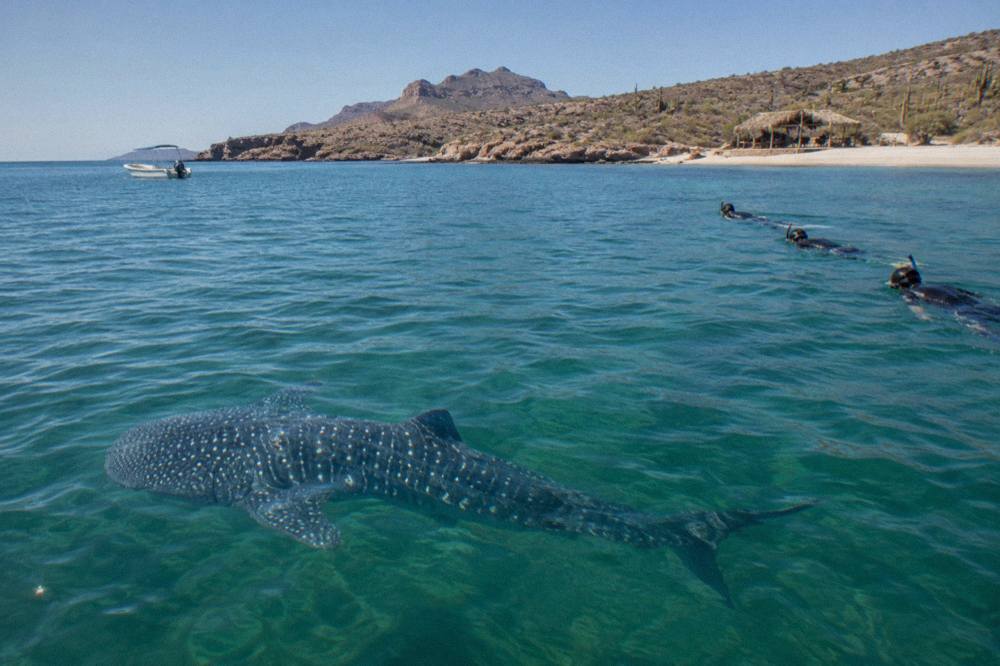
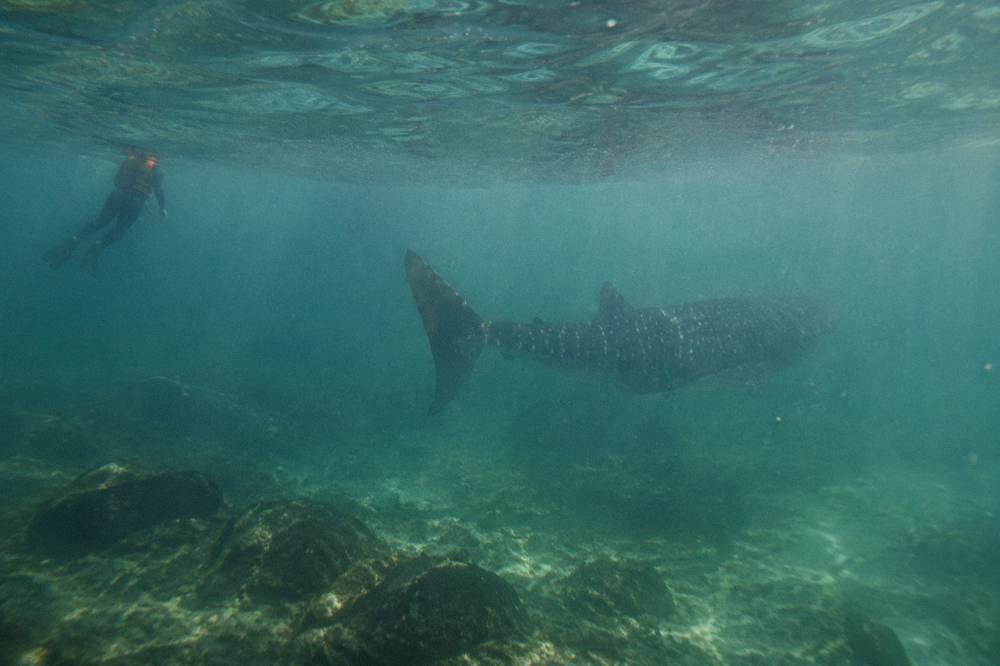
Swimmers must stay at least 2 m from a whale shark's head and sides, and at least 3 m from its tail fin. Boats may not come closer than 5 m to the animal, must approach from behind and parallel to its path, and hold a maximum of 7 knots, dropping to 3 knots where sharks aggregate. One boat per shark or group, for 30 minutes maximum.
The distances are not suggestions. The 3 m behind the tail exists because the caudal fin of a several-meter shark moves with force that a swimmer in its arc cannot outrun. Guides are required to control the activity of 5 swimmers and keep the group together, which is why a well-run tour puts a guide in the water beside you rather than shouting directions from the boat.
The 30-minute rule is about the shark, not the swimmers. One boat per shark or group, maximum, and other boats must wait 50 m away rather than queueing on top of the encounter. Swimmers are dropped from a position roughly 15 m ahead of the animal with the engine in neutral, so the shark swims toward the group rather than being chased. A reader wanting the fuller practical picture of how a swim unfolds can read what to expect swimming with whale sharks in La Paz; this page stays on the rules themselves.
| Rule | The number | Why it exists |
|---|---|---|
| Distance from head and sides | 2 m minimum | Keeps swimmers off the animal's sensory line |
| Distance from tail fin | 3 m minimum | The tail sweep is the main injury risk |
| Swimmers per specialised guide | 5, kept together | A guide must control the group's position |
| Time with one shark or group | 30 minutes maximum | Limits disturbance to the animal |
| Boat distance from the shark | Not closer than 5 m | Boat hull and propeller risk |
| Waiting boats | 50 m away | Prevents crowding by other vessels |
| Approach speed | 7 knots maximum, 3 knots in aggregations | Approach from behind and parallel |
How Many Swimmers And Boats Are Allowed At Once In La Paz?
Each specialised guide takes 5 swimmers at a time, and the 2026-27 aviso caps boats in the swim zone by the day's official shark count: at least 6 sharks must be present for any trips, with 6 sharks allowing 6 boats per shift and 24 per day, rising to a hard cap of 14 boats per shift and 56 per day when 14 or more sharks are counted. Boats may not exceed 11 m in length.
The sliding scale is the part of the rulebook most visitors never hear about, and it explains the rhythm of a La Paz morning. Counts are calculated from the average of the two most recent official CONANP counts, rounded up. If the count falls to five or fewer sharks, operations stop entirely for the day, which is what happened in late January 2025 when counts of 9, 5 and 1 sharks triggered a suspension. In a season like 2025-26, which closed with 56 individual sharks identified and 950 sightings recorded, the zone stays busy; in a thin fortnight it can empty out.
No public maximum for passengers per boat appears in the norm or the aviso, so treat any number a seller quotes as their own policy rather than law. The roster's listings state their own caps where they have them: the Eco Migrations swim, 4.8 from 56 reviews at from $194 per person, runs shared groups of up to 6, and several island combos cap at 8, 9 or 10 guests. Group size on the listing is a fair proxy for how strictly the 5-swimmers-per-guide rule can be honored in practice.
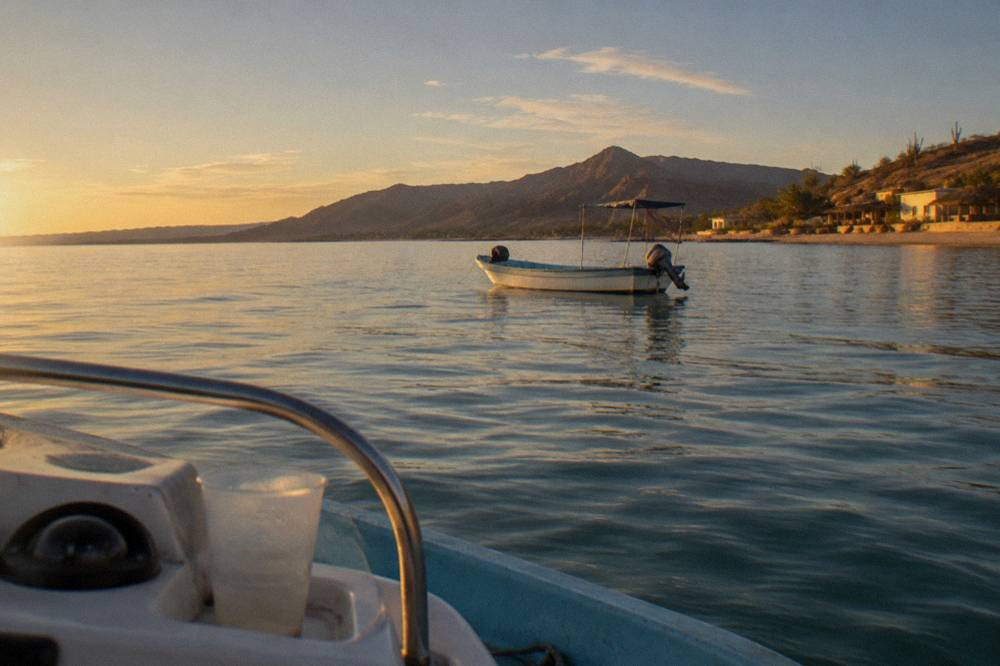

For swimmers, the practical consequence of the four-shift system is that departure slots are assigned by the authorities rather than chosen freely, and operators commonly confirm the exact meeting time the evening before. Most listings meet at the Muelle Fiscal pier on the Malecon or at Marina de La Paz on Calle Topete; the details are in each operator's listing.
What Is Banned During A Whale Shark Swim In The Bay Of La Paz?
Touching, riding or pursuing a whale shark is prohibited outright, as are selfie sticks, flash and artificial light, motorised propulsion devices, and non-biodegradable sunscreen. Swimmers must wear a life vest or a wetsuit, and the encounter with any individual shark ends immediately if it shows evasive swimming, defensive tail strikes or sudden dives.
The touching ban is the one with teeth in public debate, and it is absolute. No hand on the animal, no grabbing a fin for a ride, no chasing. Feeding falls under the same logic: the activity is classed as non-extractive observation, and anything that changes the shark's behavior is outside it. The whale shark is listed as threatened under NOM-059-SEMARNAT-2010, and PROFEPA, coordinating with CONANP, inspects boats and verifies authorizations on the water.
The gear rules are simpler than they look. A life vest or wetsuit is mandatory in the water, which is why nearly every La Paz listing bundles one or the other into the price. Only biodegradable sunscreen may be applied before entering the water, and many guides prefer a rash guard and no sunscreen at all. Photos are allowed, but no selfie stick and no flash or artificial light, because both alter how the animal behaves around swimmers. The stop rule matters too: if a shark dives, strikes its tail defensively or swims evasively, the interaction with that animal is over, and a good guide calls the group back without waiting to be asked.
| Prohibited in the water | Required in the water |
|---|---|
| Touching, riding or pursuing the shark | Life vest or wetsuit |
| Feeding | Biodegradable sunscreen only, if any |
| Selfie sticks | Staying with the guide's group of 5 |
| Flash or artificial light | 2 m from head and sides, 3 m from tail |
| Motorised propulsion devices | Ending the swim if the shark shows evasion |
What to pack for a compliant swim, wetsuit thickness and reef-safe sunscreen included, is covered in the what to bring guide; the ethics behind the no-touch rule get their own treatment in the site's piece on whether swimming with whale sharks is ethical.
How Do You Spot An Authorized Whale Shark Boat In La Paz?
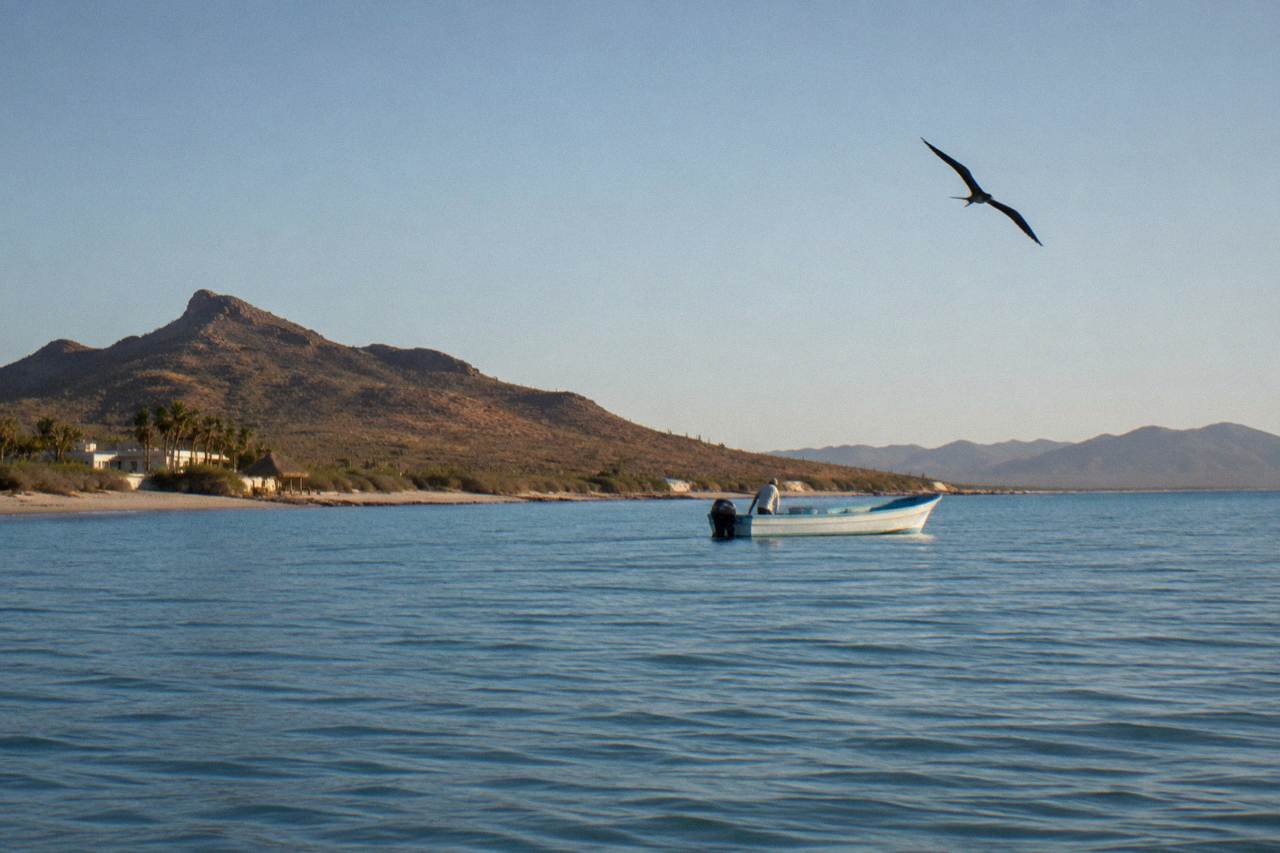
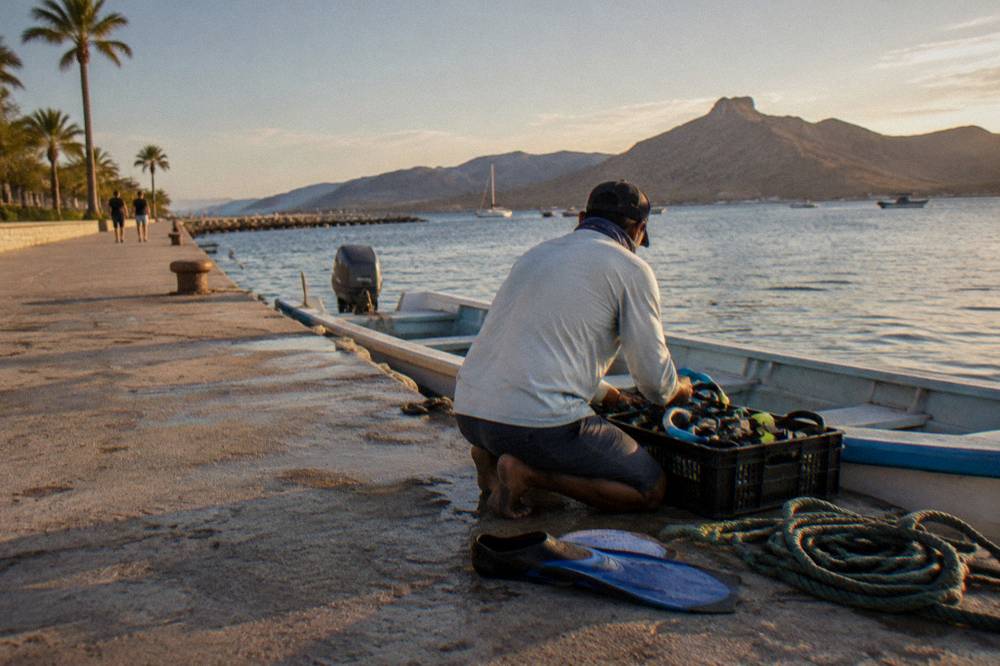
Three checks confirm a legal operator: the boat is no longer than 11 m, a SEMARNAT pennant, the banderola, is displayed, and a copy of the SEMARNAT authorization is carried on board. For 2026-27 only 112 such authorizations exist in La Paz, each tied to one holder and one boat, and the governor has stated the permits go exclusively to local service providers.
The pennant is the visible one. The 112 banderolas were physically delivered to operators for the new season, and every authorized boat flies one. No public list of the 112 holders has been published, so there is no registry to search from a hotel room; the check happens at the dock, or you trust the operator's paperwork sight unseen. That is a fair argument for booking through an established listing rather than a beachfront handshake, and for choosing operators whose product page names the permits, as the MeXplore marine-biologist small group does.
It is also a fair argument for the listings that keep groups deliberately small. The premium reduced-group encounter from La Paz Whale Sharks VIP Tours, 5.0 from 422 reviews at from $295 per person, markets itself on exactly this territory, and Orza Tours runs a private charter at from $1,168 per group for swimmers who want the whole boat and the guide's attention to themselves. None of that substitutes for the pennant, but a small-group operator has fewer reasons to cut corners.
One nuance worth knowing: the same operator can run several different listings with different inclusions and departure points. MeXplore appears on this site both with its small-group swim from Topete 125 and with a six-hour whale shark, sea lion and Balandra combo, 4.9 from 73 reviews. Treat each listing as its own product, and re-check the inclusions on whichever one you book. The comparison page on La Paz Whale Shark Tours walks through how the listings differ.
What Zones Divide The Whale Shark Refuge In La Paz?
The Bahia de La Paz refuge splits into three zones: Zone I is the only area where swimming and watching whale sharks is allowed, Zone II is a conservation area where no activity with the species is permitted, and Zone III is a transit zone where boats may not stop for sharks and must hold 7 knots, about 12.9 km/h.
Zone boundaries explain a lot of what happens on the water. Boats leave the marina, run out through the transit zone at capped speed, and only slow to approach speed inside Zone I where sharks are working. Because one boat per shark is the limit and waiting boats hold 50 m back, a morning in the zone looks orderly from the surface: a ring of small boats holding position, each waiting its half hour.
The zoning also explains why a La Paz swim is a half-day commitment rather than an all-day one. Operators report 20 to 40 minutes of boat time from the dock to the swim zone and 3 to 5 hours on the water altogether, against the durations on this site's roster, where most shared swims run 2 to 4 hours. The aviso's four daily shifts spread the authorized boats across the day so that no more than 14 authorized boats work the zone at once.
Do Espiritu Santo And Balandra Rules Apply To Combo Tours From La Paz?
Yes, and they are separate rules on top of NOM-171. Sea lion swims at Los Islotes in the Espiritu Santo park close entirely from 1 June to 31 August for the reproductive season, the swim subzone there is capped at 180 people at once, and Playa Balandra admits visitors in two daily turns of 450 people with a reported MXN 120 per person conservation fee, confirm on the day.
The combo listings on this site, which pair the whale shark swim with sea lions and a Balandra or Espiritu Santo stop, are stitched together from three different rulebooks, and each leg carries its own constraints. The Espiritu Santo park charges its own reported conservation wristband, MXN 225 per person per day, again to confirm on the day; many combo listings fold permits and fees into the price, but read the inclusions line to be sure. The park management plan is the source for the Los Islotes cap and closure, and the site's Espiritu Santo island tour guide covers the practical side.
On the roster, the combos make the permit handling visible. Tuna Tuna Tours' six-hour whale shark, sea lion and Balandra combination, 5.0 from 113 reviews at from $234 per person, lists all fees and taxes, lunch, wetsuits and even underwater photos among its inclusions. The MeXplore equivalent covers federal permits and the whale shark conservation donation. Balandra's turn system is the schedule constraint: a combo that aims for the beach in the afternoon is working around a fixed 13:00 to 17:00 window and a hard cap of 450 visitors.
Visitors based in Los Cabos get the same La Paz rules wrapped inside a much longer day. The Cabo Adventures tour from Los Cabos, the roster's most reviewed listing at 4.9 from 1141 reviews and from $259 per person, runs about 10 hours with hotel pickup and drives to La Paz, where the identical pennant, distance and group rules apply on the water. The site's guide to the Cabo to La Paz day trip works through whether that trade makes sense.
The short version for every one of these products: the whale shark leg is governed by NOM-171 no matter which boat, which marina or which booking page sold it. The rules travel with the species, and so does the operator's obligation to show you the pennant.
Common Questions About Whale Shark Swim Rules In La Paz
How close can you swim to a whale shark in La Paz?
Swimmers must stay at least 2 m from the shark's head and sides and 3 m from its tail. Boats may not come closer than 5 m, must approach from behind and parallel, and hold a maximum of 7 knots, 3 knots where sharks aggregate.
How many swimmers can be in the water at once?
Five swimmers per specialised guide, kept together as one group. One boat per shark or group at a time, for 30 minutes maximum, with other boats waiting 50 m away.
Can you touch a whale shark in La Paz?
No. Touching, riding and pursuing are prohibited under NOM-171-SEMARNAT-2018, and the whale shark is classed as a threatened species. The encounter also ends if the shark shows evasive swimming or defensive tail strikes.
Is sunscreen allowed on a whale shark swim?
Only biodegradable sunscreen may be applied before entering the water, and a life vest or wetsuit is mandatory. Many guides prefer a rash guard and no sunscreen at all.
How do you know a whale shark boat is legal in La Paz?
Check three things: the boat is no longer than 11 m, a SEMARNAT pennant is displayed, and a copy of the SEMARNAT authorization is on board. For 2026-27 there are 112 such authorizations in La Paz.
When can whale shark trips be suspended in La Paz?
Trips only operate with at least 6 sharks in the swim zone; with 5 or fewer, operations stop for the day. Boats per shift also scale with the official shark count, up to a hard cap of 14 boats at once.